
Central Laboratory for Environmental Microbiology
Home » Our Services » Environmental Microbiology and Water Hygiene » Central Laboratory for Environmental Microbiology
Head of Department
Dr. Nicole Knabe
Order Processing
Kerstin Blex
Cornelia Bremberg
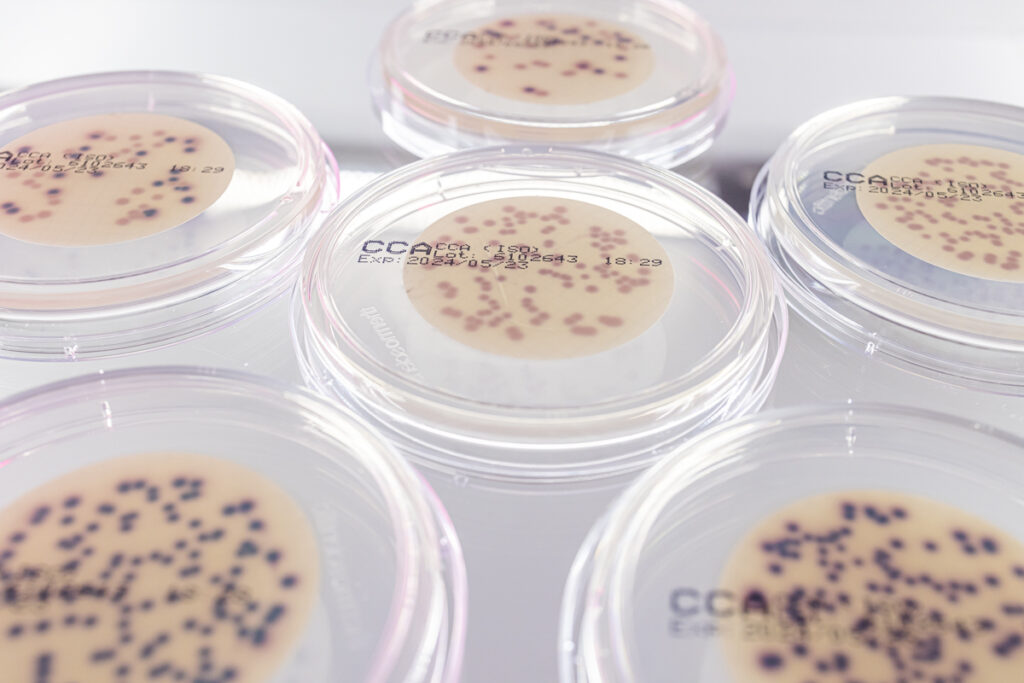
Environmental Samples
In the central laboratory for environmental microbiology, environmental samples are analyzed for the presence of microorganisms, primarily bacteria. In particular, water from drinking water supply systems, swimming pool water treatment systems, evaporative cooling systems and cooling towers, air handling systems, wastewater treatment plants, dental units, ear irrigation systems, and emergency eye and body showers is subjected to microbiological analysis.In addition, bacteria as well as moulds and yeasts are identified in surface samples (contact plates), swab samples, and materials from devices and technical equipment.
Methods and Parameters
The determination of microorganisms is primarily carried out using culture-based methods
(e.g. surface plating / direct plating,
pour plate method, membrane filtration method, Most Probable Number (MPN) method, microtiter method).
In these methods, target organisms are cultivated in or on a nutrient medium and subsequently quantified.
Biochemical and microscopic methods are also used for the differentiation and identification of the cultivated microorganisms.
In accordance with the requirements of applicable laws, regulations, and generally accepted rules of technology, as well as the guidelines of the German Environment Agency and LANUK NRW, the following target organisms are analyzed using standardized methods:
- colony count at 22 °C and colony count at 36 °C
- Escherichia coli (E. coli)
- coliform bacteria
- intestinal enterococci
- Pseudomonas aeruginosa
- Legionella / Legionella spp.
- salmonella
- Clostridium perfringens
- somatic coliphages
- moulds and yeasts
The corresponding methods can be found in the accreditation certificate.
Special investigations
Depending on the specific issue, other target organisms can also be analyzed. Examples include total bacterial count, slime-forming bacteria, iron bacteria, and sulfate-reducing bacteria.
Depending on the microbiological issue and in consultation with the client, other methods may also be applied, such as the preparation of cell suspensions from raw materials, material and surface samples, or from devices.
Through collaboration with other departments, additional methods such as scanning electron microscopy, fluorescence microscopy, and light microscopy can also be offered for the identification of microorganisms.
Recently, we have begun offering the detection of the pathogen SARS-CoV-2 in contaminated water using molecular biological methods. Using qRT-PCR analysis (quantitative reverse transcription polymerase chain reaction), various gene regions of SARS-CoV-2 are identified. Quantification of the amplified nucleic acids is carried out by comparison with an internal specific standard.Results are available within 24 to 48 hours after the samples arrive at the laboratory. This method is typically applied to influent wastewater (cooled 24-hour composite samples) from wastewater treatment plants.
For more information on our wastewater monitoring for SARS-CoV-2, please feel free to contact us.
Our Fields of Expertise in Environmental Microbiology & Water Hygiene
Discover our specialized services in the analysis of drinking water installations and the assessment of Legionella risks. Learn more about our solutions for ensuring safe and hygienic water quality.