
Limnology
Home » Our Services » Limnology
Head of Department
Dipl.-Biol. Daniela Thönnes
Head of Unit
Lasse Ufermann, M.Sc.
Biology of Inland Waters
Water is a valuable resource in many respects and continues to be exposed to numerous anthropogenic pressures. Two core areas of the Hygiene Institute – preventive environmental and health protection – are particularly closely interlinked in this context.
Within the Department of Limnology (literally “the study of inland waters”), all aspects relating to the biology of inland waters and microscopy are addressed. A motivated and growing team maintains expertise that is becoming both increasingly important and increasingly rare.
Our range of services … at a glance
- Cyanobacteria: identification, monitoring, toxin analysis (see below)
- Phytoplankton and benthic diatoms
- Macrozoobenthos: PERLODES assessment and saprobic index
- Ecotoxicology, e.g. fish egg test and fish embryo test
- Analysis of bathing waters (lake and river bathing sites)
- Analysis of biologically treated bathing facilities (natural pools, swimming ponds)
- Analysis of reservoirs and gravel pit lakes, including depth profiling
- Microscopic activated sludge analysis
- Specialized microscopic analyses (see below)
- … and much more relating to your water body
Recreational use of bathing waters
Numerous bathing sites at lakes, rivers, or coastal areas in Germany offer opportunities for nature experience, recreation, cooling, and sports. At official EU bathing sites, you can rely on regular monitoring of key parameters to ensure the best possible water quality for all users. Both routine sampling in accordance with the EU Bathing Water Directive and the Bathing Water Ordinance of North Rhine-Westphalia, as well as urgent special sampling, fall within the scope of the Department of Limnology.
“What is this?” Microscopic analyses
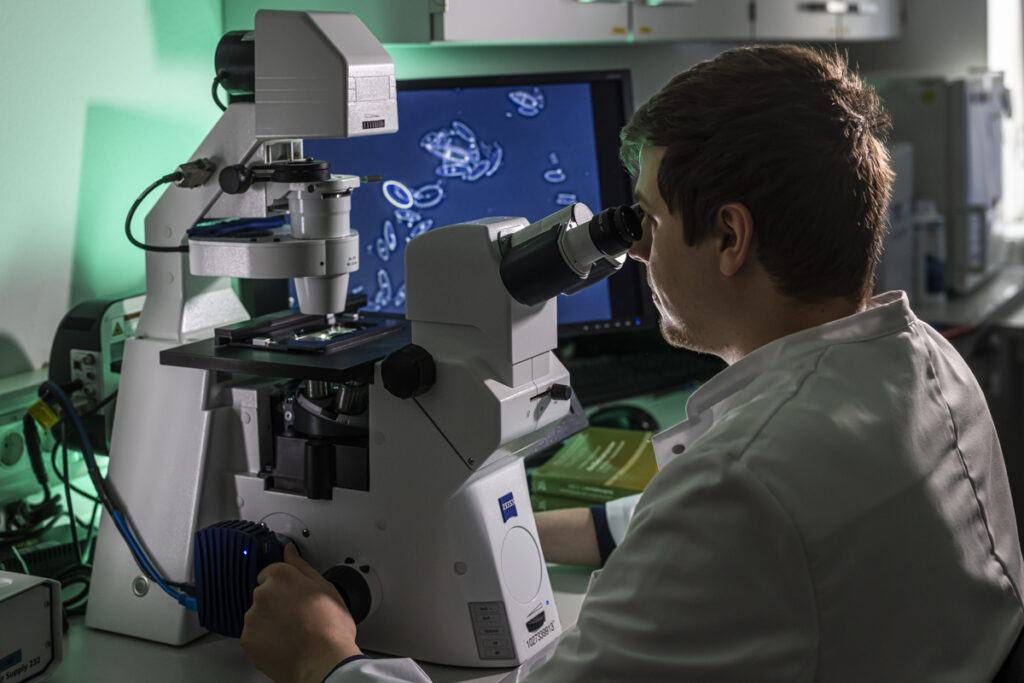
Whether unknown deposits occur in industrial or private buildings or a body of water shows unusual discoloration, many questions can be answered using expert light or fluorescence microscopy.
Cyanobacterial toxins: microcystin & more
In ponds, bathing lakes, or drinking water reservoirs, cyanobacteria (“blue-green algae”) are occurring more frequently and can cause various problems. For human water use, they are particularly relevant due to their ability to produce toxins. The most well-known toxin is the hepatotoxic microcystin.
With the inclusion of the parameter microcystin-LR in the Drinking Water Ordinance, this risk has been addressed. Since 2020, we have offered the determination of the microcystin-ADDA content as a sum parameter within the scope of our accreditation.